Agility is not a personality trait you either have or do not have. It is a set of skills you can build, practice, and strengthen. And for administrative professionals, agility has become one of the clearest markers of value.
The pace of business is faster. Expectations are higher. Tools and priorities shift midstream. Leaders need steady support that still moves quickly. That is why the 12 Dimensions of Agility matter. Together, they create a complete journey that develops you from capable and reliable to adaptive, strategic, and influential.
If you are the person who keeps things moving when the plan changes, these dimensions put language and structure around what you already do. If you are still growing into that confidence, these dimensions show you exactly what to build next.
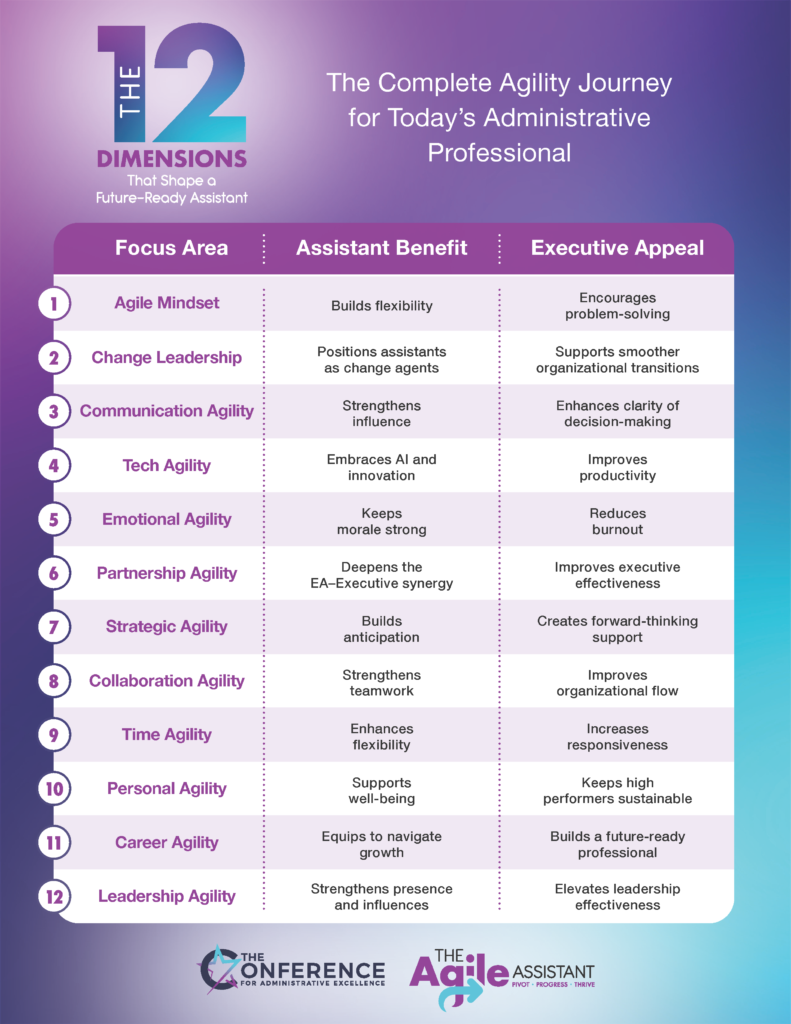
In the downloadable visual included in this post, you will see each dimension paired with an “Assistant Benefit” and an “Executive Appeal,” which helps you connect your skill growth to what leaders value most.
Why this is a complete journey, not 12 separate tips
Each dimension strengthens a different pressure point in the role. Some help you think better under uncertainty. Others help you lead change, communicate with influence, or keep performance consistent when demands collide. The magic is the combination. When you develop all 12, you become a professional who can pivot without panic, protect priorities without friction, and elevate outcomes without needing formal authority.
Below is a practical guide to each dimension, why it matters, how it benefits your role, and simple ways to apply it immediately.
1) The Agile Mindset: Thinking on Your Feet
Why it matters: Your mindset is the foundation. If uncertainty triggers stress, everything else feels harder. If uncertainty triggers curiosity, you move faster and make better calls.
How it benefits your role: You stay composed, flexible, and solution-oriented. In the visual, this shows up as building flexibility and encouraging problem solving.
Tips to build it
- Replace “What do I do?” with “What is true right now, and what is the next best step?”
- Keep a short list of “default responses” for sudden changes: clarify the outcome, identify constraints, propose options.
- Practice reframing: “This change is frustrating” becomes “This change reveals what needs strengthening.”
2) Change Leadership for Administrative Professionals
Why it matters: Change is rarely clean. It is messy, emotional, and political. Assistants are often the bridge between the decision and the reality of implementation.
How it benefits your role: You move from reacting to change to guiding it. The visual frames this as positioning assistants as change agents and supporting smoother organizational transitions.
Tips to build it
- Ask early: “What is changing, who is impacted, and what does success look like?”
- Create a simple change map: key stakeholders, key messages, key milestones, common friction points.
- Be the calm center: summarize decisions, clarify next actions, and reduce uncertainty for others.
3) Communication Agility
Why it matters: A message that works for one person may fail with another. Agility means you can flex your tone, detail level, and format while staying clear and credible.
How it benefits your role: You strengthen influence. The visual connects this to clearer decision-making for leaders.
Tips to build it
- Match the receiver: do they want bullets, context, or a recommendation?
- Use a “three-layer” approach: headline, key points, optional detail.
- Confirm the channel: sensitive topics deserve a conversation, not a long email thread.
4) Tech Agility: Mastering Tools for Tomorrow
Why it matters: Tools change faster than job descriptions. The assistants who thrive are not the ones who know every tool, but the ones who learn tools quickly.
How it benefits your role: You embrace innovation, including AI, and improve productivity for your executive and your team.
Tips to build it
- Adopt a simple learning loop: explore, test, document, teach.
- Keep a “tool transition cheat sheet” for yourself: what it replaces, what it improves, common errors, and best shortcuts.
- Use AI wisely: start with low-risk tasks like drafting, summarizing, reformatting, or brainstorming.
5) Emotional Agility and Resilience
Why it matters: Pressure is part of the role. Emotional agility lets you respond rather than react, especially when timelines collapse or conflict rises.
How it benefits your role: You keep morale strong, reduce burnout risk, and stay steady under disruption.
Tips to build it
- Name what you feel, then choose what you do. That pause is power.
- Create a reset routine that fits your day: a short walk, a breathing pattern, a quick recap list.
- Do not carry other people’s urgency as your identity. You can be responsive without absorbing stress.
6) Partnership Agility: Navigating the Dynamic Executive Relationship
Why it matters: Executive needs shift with business cycles, personal workload, and leadership pressures. Partnership agility is the ability to keep alignment even while the target moves.
How it benefits your role: You deepen synergy and improve executive effectiveness.
Tips to build it
- Hold short alignment check-ins: priorities, risks, meetings that matter, decisions pending.
- Learn your executive’s “decision style”: fast vs deliberative, data heavy vs people centered.
- Anticipate without overstepping: offer options, not assumptions.
7) Strategic Agility
Why it matters: Being busy is not the same as being valuable. Strategic agility is seeing what is coming and positioning your support accordingly.
How it benefits your role: You build anticipation and create forward-thinking support.
Tips to build it
- Ask “What is the purpose?” before “How fast can I do it?”
- Track recurring friction: what keeps breaking, delaying, or requiring last-minute saves?
- Build a simple “executive dashboard” for yourself: top priorities, deadlines, stakeholders, risks, follow-ups.
8) Agility in Collaboration and Team Dynamics
Why it matters: Teams are cross-functional, multi-generational, and often distributed. Collaboration agility helps you work effectively with many styles without losing your own.
How it benefits your role: You strengthen teamwork and improve organizational flow.
Tips to build it
- Clarify roles early: who owns, who supports, who approves.
- Use shared language: deadlines, handoffs, and decision points written down reduce drama.
- Be the connector: surface dependencies and resolve bottlenecks before they explode.
9) Time Agility: Managing Priorities in a Fast-Paced World
Why it matters: Priorities will change. Your job is not to prevent change, but to manage it without losing control of the day.
How it benefits your role: You enhance flexibility and increase responsiveness.
Tips to build it
- Protect two lists: “must happen today” and “can move without consequence.”
- Use a rapid reprioritization script: “If we do this now, what moves, what breaks, and what needs approval?”
- Confirm what “urgent” means. Many requests are urgent feelings, not urgent outcomes.
10) Personal Agility and Well-Being
Why it matters: If your energy is depleted, your agility disappears. Well-being is not separate from performance. It is what makes performance sustainable.
How it benefits your role: You support well-being and keep high performers sustainable.
Tips to build it
- Create boundaries that protect your best work hours.
- Build “micro recovery” into your day: five minutes between high-intensity tasks.
- Replace perfection with standards: define what “good and complete” looks like for recurring work.
11) Career Agility
Why it matters: The role is evolving. Career agility means you stay employable, promotable, and confident in your trajectory.
How it benefits your role: You navigate growth and build a future-ready professional profile.
Tips to build it
- Keep a skills inventory: what you do, what you can prove, what you want next.
- Build visibility the right way: document wins, share metrics, and connect work to outcomes.
- Stretch intentionally: volunteer for projects that build strategic, tech, or leadership credibility.
12) Leadership Agility
Why it matters: Leadership is not a title. Assistants lead through influence, clarity, trust, and how they shape outcomes.
How it benefits your role: You strengthen presence and elevate leadership effectiveness across the organization.
Tips to build it
- Practice calm directness: clear asks, clear boundaries, clear follow-up.
- Facilitate decisions: summarize choices, tradeoffs, and recommend next steps.
- Lead culture in small moments: how you respond sets the tone for others.
Two real-world use cases
Use case 1: The sudden executive reshuffle
Your leader is asked to take on an expanded scope with minimal notice. Calendars are chaos, stakeholders are nervous, and priorities conflict.
How the dimensions help
- Agile Mindset keeps you calm and focused on what is true right now.
- Change Leadership helps you map stakeholders and create clarity.
- Partnership Agility helps you reset expectations with your executive quickly.
- Time Agility lets you restructure priorities without losing critical deadlines.
- Communication Agility ensures updates land well across different audiences.
One practical move: Create a one page “transition snapshot” for the first two weeks: top meetings, top relationships, top risks, and immediate decisions.
Use case 2: AI is introduced, and the team is uneasy
A new tool is rolled out. Some people are excited, others are skeptical, and there is fear about mistakes or job impact.
How the dimensions help
- Tech Agility helps you learn the tool and document simple workflows.
- Emotional Agility helps you stay grounded and reduce tension.
- Collaboration Agility helps you bring people along without forcing adoption.
- Strategic Agility helps you focus on where the tool improves outcomes, not where it just adds novelty.
- Leadership Agility helps you influence the culture and create safe learning norms.
One practical move: Offer a “low risk test batch” of tasks where AI can help without reputational risk, then share what worked and what did not.
Where to go from here
If you want a strong next step, do not try to master all 12 at once. Pick two dimensions that would remove the most daily friction for you right now. Build small habits for 30 days. Then add the next two.
And if you want to accelerate your growth with live training, real examples, and practical tools built for the administrative role, these 12 Dimensions of Agility are the theme and core learning journey at the 2026 conference hosted by Office Dynamics International. It is designed to help you pivot faster, partner stronger, and thrive in the real pace of modern business.